Identifying Vintage Brooches: Marks and Materials
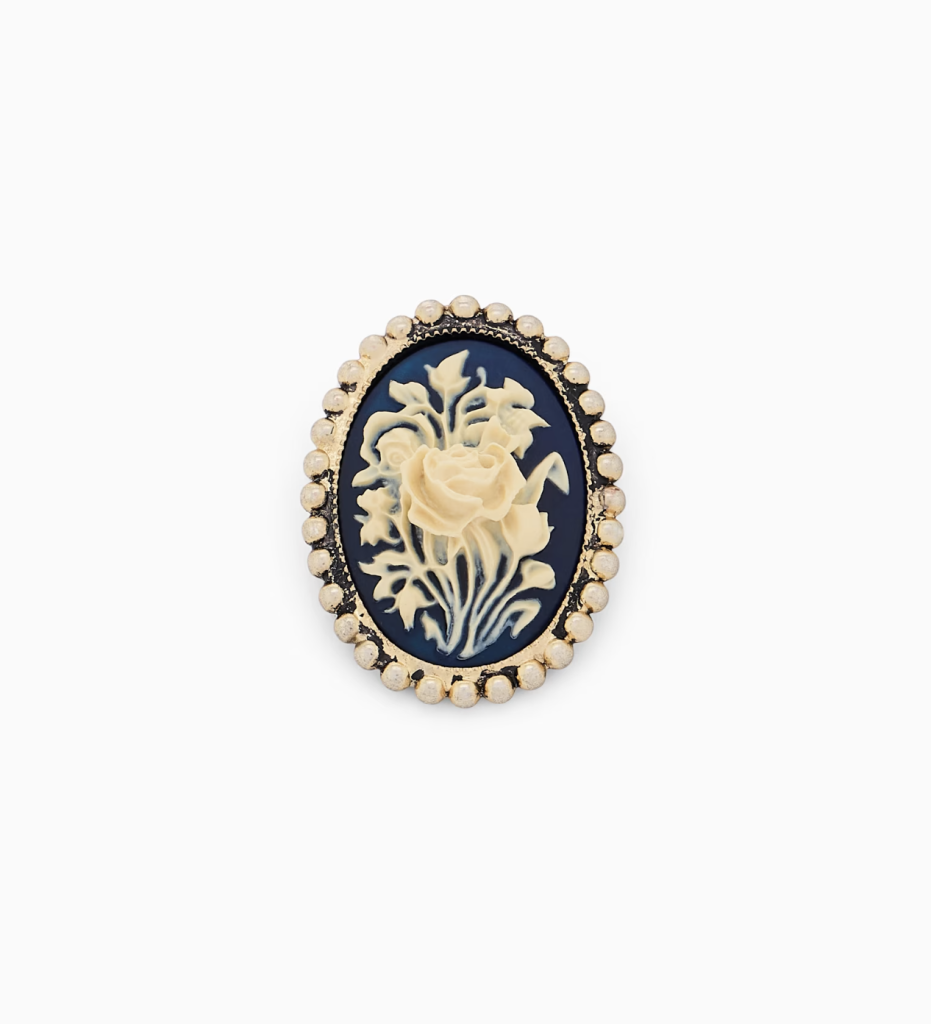
Vintage brooches are among the most collectible and widely traded pieces of costume and fine jewelry, yet they are also among the most frequently misidentified. A single brooch can carry a maker’s mark, a country-of-origin stamp, a patent number, and a plating designation, and each of these details contributes to how the piece is understood and valued. Learning to read these marks methodically, rather than relying on appearance alone, is the foundation of sound identification.
This guide outlines a structured approach to examining vintage brooches. It covers the categories of marks typically found on the back of a piece, the signatures of well-known makers, the materials and finishes commonly encountered, and the physical tests that can help narrow down composition. It also addresses the practical question of reproductions, which appear regularly at flea markets and estate sales and are often presented without any claim of authenticity.
The emphasis throughout is on observation and documentation. Identification is rarely a single decisive step; it is usually an accumulation of small, verifiable details that together support a reasonable conclusion. Treating each brooch as a small research project tends to produce more reliable results than quick visual judgments.
Reading Marks on the Reverse of a Brooch
The back of a brooch is where most identification evidence lives, and it deserves careful examination under good light and magnification. Marks are commonly stamped, engraved, or raised, and each method leaves a different impression in the metal. A loupe of ten power is generally sufficient to distinguish a crisp die-struck mark from a shallow or uneven stamp applied after casting, which is one of the more useful distinctions when evaluating a piece.
Marks fall into several broad categories, and recognizing which category a mark belongs to helps determine what it can and cannot tell you.
- Maker’s marks and signatures, which identify the company or designer responsible for the piece.
- Country-of-origin stamps, often required for imported goods and useful for establishing a manufacturing location.
- Purity or plating designations, such as sterling, 14K, gold filled, or a specific plating thickness.
- Patent and design registration numbers, which can sometimes be traced to a filing date and an original manufacturer.
- Retailer marks, which identify the seller rather than the producer and should not be confused with manufacturing signatures.
It is important to note that the presence of a mark does not by itself confirm age or authenticity. Marks can be added later, transferred from one piece to another, or reproduced on modern castings. The relevant question is whether the mark is consistent with the object it appears on — in style, in method of application, and in the quality of the surrounding workmanship.
Signed Pieces and What Signatures Indicate
Signed costume jewelry occupies a distinct place in the market, and a signature can be a meaningful data point while remaining only one part of the overall picture. Makers active in the mid-twentieth century produced work in recognizable house styles, and a signature that matches the expected construction, materials, and design vocabulary of that maker carries more weight than a signature in isolation.
Several practical considerations apply when evaluating a signature. First, signatures vary across a company’s production history, and an early mark may differ substantially from a later one. Second, some companies used multiple marks simultaneously for different lines or price points. Third, unsigned examples of a known design are common, since not every piece was marked, and the absence of a signature is not automatically a disqualifier.
Collectors and researchers frequently rely on published references, auction archives, and maker catalogues to compare marks. Building a personal reference file of clear, well-lit photographs of marks encountered at markets and shows is a practical habit. Over time, this record supports more consistent comparisons than memory alone. The company maple-ledger maintains a similar orientation toward documented, reference-based evaluation rather than impressionistic appraisal.
A signature should also be read alongside construction details. A well-made piece from a known maker typically shows consistent soldering, secure stone settings, an even finish, and a clasp appropriate to the design. A signature attached to work that shows none of these characteristics invites closer scrutiny before any conclusion is drawn.
Materials, Finishes, and Non-Destructive Testing
Material identification in brooches ranges from straightforward to genuinely difficult, and a graduated approach is generally the most useful. Visual inspection comes first: the color of the metal at wear points, the presence of flaking or wear-through on plated surfaces, the weight of the piece in hand, and the appearance of stones under magnification all provide initial information. Plating wear often reveals a base metal of a different color at high-friction points such as the clasp, the pin stem, and the edges of the frame.
Simple physical observations can add useful context. A magnet will attract ferrous base metals but not sterling silver, gold, or most copper alloys, although some plated pieces with steel components will respond. A gentle rub with a soft cloth on a hidden area can reveal tarnish patterns consistent with silver. Stones can sometimes be distinguished by temperature and by the behavior of inclusions under magnification, though visual assessment of gemstones has clear limits.
Chemical and destructive tests should be approached with caution and generally left to qualified professionals. Acid testing, scratch testing, and stone testing all carry some risk to the object, and the results are only as reliable as the technique used. For a piece of uncertain value, the more prudent course is to document observations thoroughly and seek a professional opinion rather than apply a test that may cause irreversible damage. Any conclusions reached through testing should be treated as provisional and dependent on the method’s accuracy and the examiner’s experience.
Construction Details as Dating Evidence
Construction features often provide more reliable dating evidence than surface appearance, because they reflect the manufacturing technology available at the time. The type of clasp, the style of the pin stem, the method of attaching stones, and the nature of the backing all changed over the decades in ways that can be observed and compared.
The following features are commonly examined when estimating a production period:
- Clasp type and mechanism, including rollover clasps, safety catches, and tube clasps, each associated with particular eras of production.
- Pin stem construction, including the thickness of the stem and the way it is hinged to the frame.
- Stone-setting method, whether prong-set, glued, or set into a cast recess, and the finish of the settings.
- Solder joints and the visible quality of assembly, which often reflect the scale and standards of the workshop.
- Surface finish and plating thickness, which can indicate the price tier the piece was made for.
These features should be read together rather than individually. A single unusual clasp proves little, but a consistent pattern of features pointing toward the same period is meaningful evidence. Recording observations in a consistent format — photographs of front, back, clasp, and marks — allows comparisons over time and reduces reliance on recall.
Recognizing Reproductions at Flea Markets
Flea markets are rewarding places to study vintage brooches, and they are also where reproductions are most commonly encountered. Reproduction pieces are not always sold with deceptive intent; many are openly marketed as new or as copies. The identification challenge arises when a piece is presented as older than it is, and the response is careful observation rather than accusation.
Several patterns recur often enough to be worth noting. Cast reproductions frequently show a uniform, slightly soft surface where the original would show fine tool marks. Marks on reproductions are often applied after casting and may sit inconsistently with the surrounding surface. Stones may be uniformly bright and perfectly matched in a way that suggests modern manufacture, and clasps may be of a type inconsistent with the design vocabulary of the period the piece imitates. Weight is another indicator, since many reproductions are lighter or heavier than the originals they copy.
Identification is cumulative: no single feature settles a question, and the most defensible conclusions rest on several independent observations that agree.
Practical habits support better decisions in a market setting. Bring a loupe and a small magnet, photograph marks clearly, and avoid pressure to decide on the spot. Comparing a candidate piece against documented examples, rather than against other items on the same table, reduces the influence of context. Where value or provenance matters significantly, a professional evaluation remains the appropriate step, and the observations gathered beforehand make that evaluation more productive. The limits of any informal assessment should be acknowledged, since material composition, age, and authenticity each depend on factors that cannot always be resolved at a market stall.